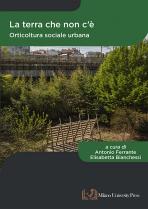
La terra che non c'è. Orticoltura sociale urbana
Keywords:
soilless cultivations, urban cultivation, social involvement, contaminated soils, social design, community design participation, active citizenship, solidarity circular economySynopsis
The book describes an action-research project aimed at responding to the needs generated by new forms of poverty, both social and economical, laid bare by the Covid Pandemic in Via Padova Area, in Milan. This area, a multi-ethnic neighborhood in the periphery of the ‘City of the Rich’, is marginal in the Greater Milan. As a response to this state of crisis, relying on a solid territorial network of third sector entities, “La terra che non c’è” – The Unexisting Land, – has used a series of abandoned, underused or inactive lands, to produce fresh food, with the scientific coordination of the Department DISAA – University of Milan. By applying soilless cultivation tecniques, it has created self-built vegetable gardens, managed with the inhabitants of the neihbourhood. “La Terra che non c’è” - The Unexisting Land has therefore built an innovative urban horticultural community, made up of young students, voluteers, the elderly, the disabled, which donates its products to those who are socially in need, to the invisible people of the neighborhood, thus creating a supportive circular community.
Downloads
References
Published
Categories
License

This work is licensed under a Creative Commons Attribution-NonCommercial-ShareAlike 4.0 International License.