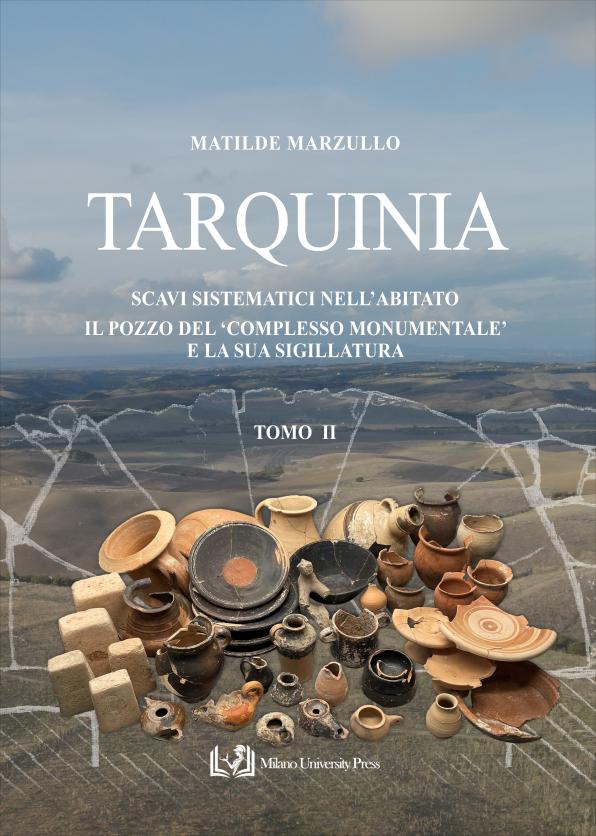
Tarquinia. Scavi sistematici nell'abitato. Il pozzo del 'complesso monumentale' e la sua sigillatura
Keywords:
Etruscans, Tarquinia, Well, Closure ritual, Votive furnishingSynopsis
The volume documents the obliteration of a well over 21 metres deep, discovered within the sacred area of the ‘monumental complex’ of Tarquinia. It is the fifth in the main Tarchna series and stands in continuity with the previous volumes presenting the results of the University of Milan’s excavations at Tarquinia.
The first section is devoted to the excavation and closure of the well, reconstructing the stratigraphic palimpsest and the underlying motivations for the intervention. The second section identifies the diagnostic criteria for interpreting the finds, while the third is dedicated to the complete publication of the materials recovered, through contributions from thirty authors.
The well contained votive furnishings belonging to a sacred building not yet identified, in use at least from the late fourth century BC. Analysis of the finds suggests a cult associated with the principal female divinity of the ‘monumental complex’. with evidence reaching back to even earlier periods. The body of evidence indicates that these were furnishings once in use within the sacred area, ritually preserved over time and deposited in the well at the moment of its closure, which took place in the second century BC in the context of a solemn ceremony.
This obliteration reflects practices shared across the Etrusco-Italic region, involving ritual gestures intended to preserve the memory of earlier cults. Sacred buildings and objects were taken out of use by institutions still politically and religiously autonomous, determined to maintain their memory intact at the dawn of the process that would draw the whole of Etruria into the centralising orbit of Rome.
Downloads
Downloads
- TARCHNA V - TOMO II vol 1 TARCHNA V - TOMO II vol 1
- TARCHNA V - TOMO II vol 2 TARCHNA V - TOMO II vol 2
Published
Series
Categories
License

This work is licensed under a Creative Commons Attribution-ShareAlike 4.0 International License.