
Introduzione alla calcolabilità teorica ed effettiva
Synopsis
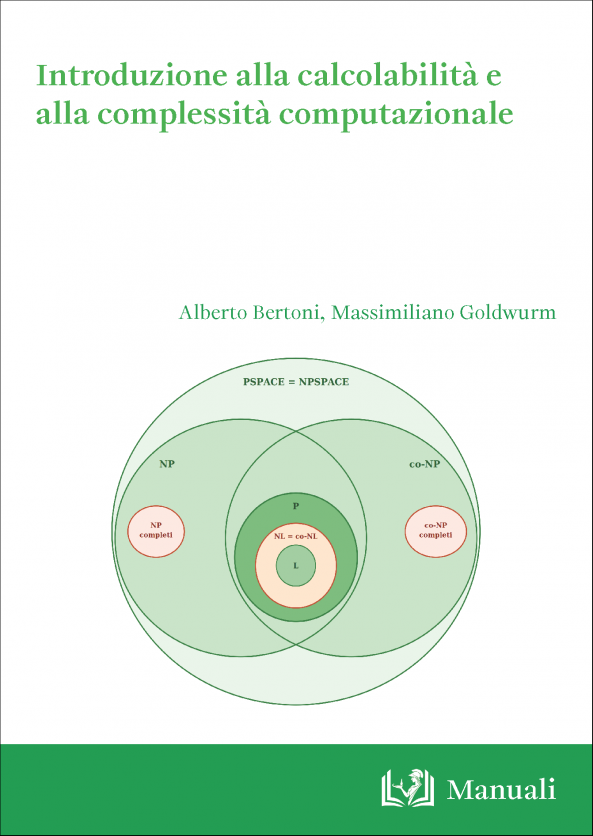
The computability of functions and the computational complexity of problems are classical subjects of Theoretical Computer Science. This work presents the main aspects of these topics with a didactic and educational goal. The notion of computability is related to the existence of an algorithm to determine the values of a function or to solve a problem. In this context it is also relevant the study of problems and functions that do not admit algorithms. On the other hand, computational complexity concerns the analysis of the resources (usually time and space) required by an algorithm to solve a given problem or compute a certain function. These topics are considered at the basis of a university curriculum in Computer Science or in Mathematics, and this presentation is devoted in particular to the students of scientific degree programs.
Downloads
References
[1] A.V. Aho, J.E. Hopcroft, J.D. Ullman, The design and analysis of computer algorithms, Addison-Wesley, 1974.
[2] S. Arora, B. Barak, Computational complexity: a modern approach, Cambridge University Press, 2009.
[3] A. Bertoni, Introduzione alla calcolabilità, Dispense del corso di Informatica Teorica, Università degli Studi di Milano,1990, reperibile al sito https://bertoni.di.unimi.it/Calcolabilita.pdf
[4] A. Bertoni, M. Goldwurm, Progetto e analisi di algoritmi, Dispense del corso di Algoritmi e Strutture Dati, Rapporto interno n.230-98, Dip. Scienze dell’Informazione - Università degli Studi di Milano, Settembre 2004, reperibile al sito https://bertoni.di.unimi.it/Algoritmi_e_Strutture_Dati.pdf
[5] A. Bertoni, C. Mereghetti, Dispense del corso di Informatica Teorica (A.A. 2000/2001), Dip. Scienze dell’Informazione, Università degli Studi di Milano, reperibile al sito https://bertoni.di.unimi.it/Circuiti_e_complessita.pdf
[6] T.H. Cormen, C.E. Leiserson, R.L. Rivest, C. Stein, Introduzione agli algoritmi e strutture dati (quarta edizione),McGraw-Hill, 2023.
[7] S. Crespi Reghizzi, Linguaggi formali e compilazione, Pitagora Editrice Bologna, 2006.
[8] M.D. Davis, R. Sigal, E.J. Weyuker, Computability, complexity and languages, Academic Press, 1994.
[9] A. de Luca, F. D’Alessandro, Teoria degli automi finiti, Springer-Verlag, 2013.
[10] M. Dietzfelbinger, Primality testing in polynomial time, from randomized algorithms to “PRIMES is in P”, Lecture Notes in Computer Science, vol. 3000, Springer–Verlag, 2004.
[11] C. Froidevaux,M.C.Gaudel,M. Soria, Types de données et algorithmes, Ediscience International, 1993.
[12] M.R. Garey, D.S. Johnson, Computers and intractability: a guide to the theory of NP-completeness,W.H. Freeman and Company, 1979.
[13] J.E. Hopcroft, R. Motwani, J.D. Ullman, Automi, linguaggi e calcolabilità, Pearson, Addison-Wesley, 2009.
[14] J.E.Hopcroft, J.D.Ullman, Introduction to automata theory, languages and computation, Addison-Wesley, 1979.
[15] A.J. Kfoury, R.N. Moll, M.A. Arbib, A programming approach to computability, Springer, 1982 (versione italiana: Programmazione e computabilità, ETAS Libri, 1986).
[16] C. Papadimitriou, Computational complexity, Addison-Wesley, 1994.
[17] H. Rogers, Theory of recursive functions and effective computability, MIT Press, 1967.
[18] S. Skiena, The algorithm desing manual, Springer, 2020.
[19] I. Wegener, The complexity of Boolean functions, John Wiley & Sons Inc, 1987.

This work is licensed under a Creative Commons Attribution-ShareAlike 4.0 International License.