
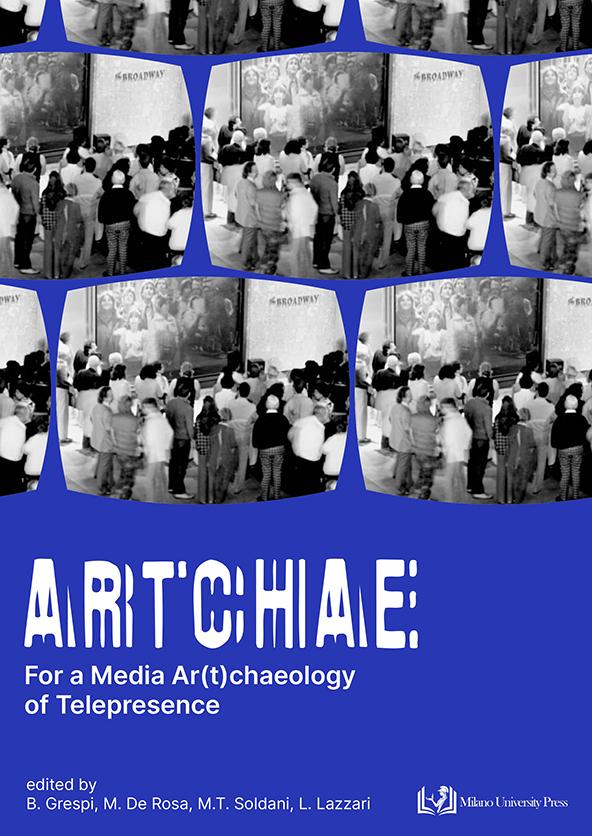
ARTCHAE. For a Media Ar(t)chaeology of Telepresence
Synopsis
Much of contemporary media entails forms of telepresence. Interaction and perception across physical distance today underpin both everyday media—such as mobile phones and teleconferencing platforms—and simulation-based media, including immersive and extended realities, which consistently incorporate a live component. ARTCHAE traces the roots of these processes to the electronic arts from the 1960s to the early 1980s—video art, installation art, and sound art—where mediated presence first became a site of experimentation, while simultaneity, embodied interaction, and self-recognition were already challenged. Combining analyses of media artworks by leading international scholars with interviews of prominent artists and curators, ARTCHAE proposes an ar(t)chaeology: a genealogical inquiry into telepresence grounded in the early insights of artists, particularly overlooked women, who explored the ways tele-media reconfigured private and public spaces, the mediation of the Self, and collective participation.
Chapters
-
Foreword
-
Introduction I Section
-
A Genealogical Approach to The Disobedience Archive
-
At the Thresholds of the Medium: CCTV, Playback, and Feedback Breaking the Possibilities of Video
-
Techno-Pop: Virtual Doubles and Dystopian Futures Around 1984
-
Navigating the Frame: Videoart, Lines of Flight, Deixis
-
Speculative Materializations in Erika Tan’s Barang Barang: Spectral Entanglements (2021)
-
Introduction II Section
-
Between Surveillance and Self-Surveillance: Feminist (Re)Visions of the Closed Circuit
-
Telephonic Presence. Marta Minujìn’s early works
-
Being There / Being Then. Rhetoric and Poetics of Tele-Presence from Art Radio to Radio-Art
-
Broadcasting and Taping Loops, Feedback, Delays, and Noises: Tele-Presence as a Time Machine
-
The Impossible Now: Limit Telepresence and Robotic Entanglement on Mars
-
Introduction III Section
-
Telepresence and Telematic Arts in Le Radici del Nuovo Archive. Interview with Maria Grazia Mattei
-
Resonating Histories. A Lecture with Matana Roberts
-
Closed-Circuit Faces: Archaeologies of the Face in Telepresence
-
An Excerpt from Other Networks: A Radical Technology Sourcebook (Anthology Editions, 2025)
-
“She Is Shrouded”: Some Exploratory Notes on Scaffolding as an Urban Practice between (Architectural) Construction and (Activist) Intervention
Downloads

This work is licensed under a Creative Commons Attribution-ShareAlike 4.0 International License.