Keywords:
mafia, Milan, violence, Memory, organised crime studies
Synopsis
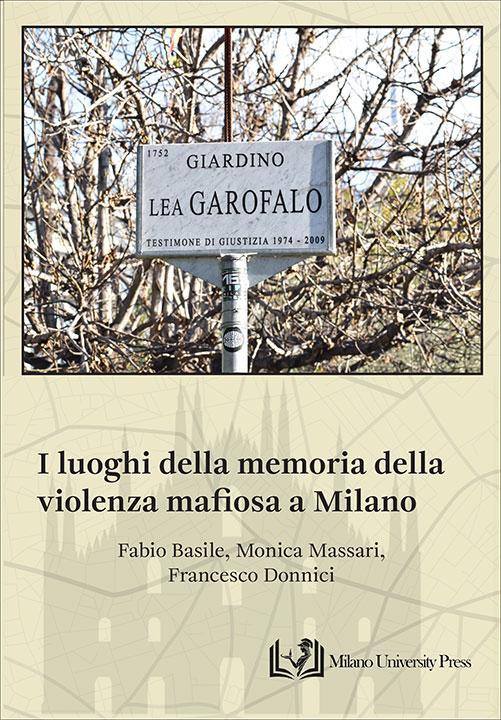
This book, developed as part of the project launched with the podcast Mafia in Milan. Places of Memory, was produced by the PhD Programme in Organised Crime Studies at the University of Milan, in collaboration with the University’s CTU, the Communication and Institutional Events Office, the Municipality of Milan, and the association Libera. It retraces nine symbolic sites in the city linked to mafia violence, through a pathway that combines scholarly rigor, narrative engagement, and civic participation. Both the podcast and the resulting book aim to contribute to the construction of a shared public memory, enhancing the university’s role in the prevention and fight against organised crime, and in promoting a culture shaped by critical reflection on the relationship between history, memory, and civic commitment.
Downloads
Download data is not yet available.
Author Biographies
Fabio Basile, University of Milan, Italy
coordinator of the PhD Program in Studies on Organized Crime, author of numerous monographs and scientific essays published in Italy and abroad, is Full Professor of Criminal Law at the University of Milan, where he also teaches Strategies to Counter Organized Crime and Preventive Measures, as well as Labour Criminal Law and Corporate Compliance, and where he coordinates the training course for criminal lawyers “Giorgio Marinucci.”
Monica Massari, University of Milan, Italy
Associate Professor, teaches Sociology of Memory, Society and Global Rights, and Comparative Social Systems at the University of Milan. Her research mainly focuses on forced migrations across the Mediterranean with particular attention to gender dynamics, processes of social construction of otherness, and new forms of racism and discrimination in Europe. She currently coordinates the University of Milan’s research unit, partner of the HORIZON2020 project “ITHACA,” the PRIN-2020 project “MOBS,” and the PRIN-2022 project “TRAMIGRART,” and is Scientific Supervisor of the HORIZON MSCA 2021 Global Fellowship “MEMODIAS” at the Department of International, Legal, Historical and Political Studies. She was elected to the Board (2023–2027) of the RC “Biography and Society” of the International
Association of Sociology–ISA. Among her most recent publications on these topics: Violence, Memory and Resistance in the Mediterranean Sea (with others, 2024), Our lives and bodies matter: memories of violence and strategies of resistance among migrants crossing the Mediterranean (in Ethnic and Racial Studies, 16/2022), and the volume Il corpo degli altri. Migrazioni, memorie, identità (2017).
Francesco Donnici, University of Milan, Italy
PhD student enrolled in the 39th cycle of the PhD Program in Studies on Organized Crime at the University of Milan. At the University of Pisa he graduated with honours in Law. He was teaching tutor of the Interuniversity Master’s in Analysis, Prevention and Countering of Organized Crime and Corruption. He is a member of the Italian Order of Journalists (list of publicists) and carried out legal practice and traineeship under Article 73 at the Anti-Mafia District Directorate of Florence. His research interests mainly concern issues related to the smuggling of migrants and the ’ndrangheta. For the “Mafie” series published by RCS, he authored two volumes on the “Rinascita-Scott” and “Gotha” trials.
Published
October 27, 2025
Copyright (c) 2025 The Author(s)